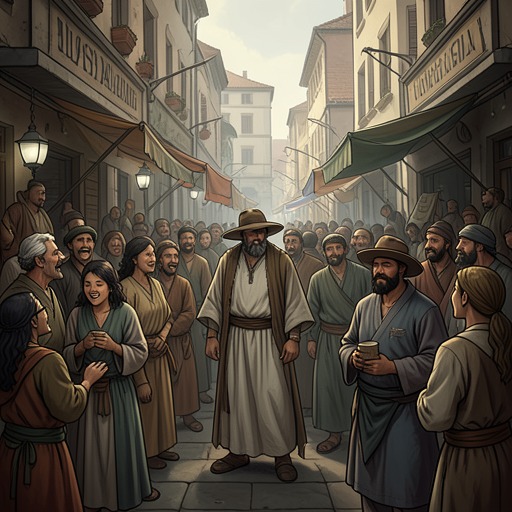
Herd morality
Thus Spoke ZarathustraHerd morality names a collective order of values that precedes individual self-assertion and is sustained by shared patterns of ruling, obeying, and belonging. In Zarathustra’s account, it is neither an eternal moral law nor merely a collection of private opinions: peoples first establish a Table of values over themselves, and the individual emerges later within that inherited order. Zarathustra’s challenge is to draw potential creators away from the herd without becoming its replacement herdsman, making the conflict over values also a conflict over how people live together and what kinds of companions they can become.
Origins and Shared Values
Zarathustra describes peoples as the first creators of values; individuals become creators only later, and even the individual is humanity’s latest creation. The order matters. The self does not begin as a fully formed judge who independently chooses a moral code. Before the individual’s I comes the You: the claims and expectations of others have already been consecrated, while the I has not. A person is therefore drawn toward the neighbour partly because the social voice is older and more authoritative than solitary self-assertion.
The herd’s Table of values is made through two complementary forms of love: the love that wants to rule and the love that wants to obey. Their conjunction creates a shared order rather than a simple rule imposed by one side. Zarathustra also observes that joy in the herd is older than joy in the Ego. The moral community is thus not only a system of prohibitions; it offers an earlier, collective source of belonging and affirmation. So long as good conscience is identified with the herd, saying I can appear as bad conscience. Individual dissent is felt not merely as disagreement with a rule but as a breach of an established moral identity.
Conformity and the Individual
This account makes herd morality a historical achievement with a continuing hold on those who inherit it. The values that seem self-evident have been created and maintained through shared attachment, including the reciprocal desires to command and comply. Their age helps explain their authority: the You has been consecrated before the I can establish its own claims. What appears to be personal moral certainty may therefore carry the pressure of collective belonging.
Zarathustra distinguishes this inherited communal basis from a later, calculating form of self-interest. The cunning, loveless Ego that seeks its advantage by attaching itself to the advantage of many is not, he says, the origin of the herd but its destruction. The contrast is not simply between society and any individual self. It separates a shared order formed through attachment from an ego that uses collective benefit as cover for private advantage. His account consequently resists reducing herd morality to either pure self-sacrifice or naked individual calculation: the first is a social history of values, while the second is a way of exploiting their established language.
Zarathustra’s Opposition and His Companions
Zarathustra’s response begins with a change in whom he means to address. He does not want to speak to the people as a herd, or to serve as their herdsman and dog. He seeks living companions who follow because they want to follow themselves, and who nevertheless want to go where he goes. The distinction is crucial: his alternative to herd obedience is not mere isolation, but a company of people whose following retains self-direction.
He expects this effort to provoke anger. The people and the herd will be angry with him, while those who call themselves good and just, or faithful to the true faith, will call him a robber. The charge follows from the stakes: the creator is hated for smashing established tables of values. Zarathustra reverses the accusation by identifying the breaker as a creator, someone who makes room for values not yet inscribed. The conflict is therefore not between moral order and simple lawlessness; it is between inherited authority and the difficult work of creating a different order.
Creation, Harvest, and the Distant
Zarathustra’s image of creation develops through harvesting. A creator seeks fellow-creators, fellow-harvesters, and fellow-rejoicers: people able to inscribe new values on new tables and to whet their sickles for the work. The creator lacks a hundred sickles and is vexed, so the image includes both abundance—everything is ripe for harvesting—and an insufficiency of companions and tools. The prospective companions may be called destroyers and despisers of good and evil, but Zarathustra presents them instead as harvesters who can rejoice in what their destruction makes possible.
This new orientation also alters the meaning of love. Zarathustra rejects neighbour-love when it functions as flight from oneself disguised as selflessness, and places love of the most distant and of the future man higher. Herd morality looks toward the consecrated You and the nearby community; the creator’s concern reaches beyond those established bonds toward people and causes not yet embodied in the present order. The distance is not indifference: it marks a commitment to a future that current values cannot simply provide. Herd morality’s deepest significance lies in this tension between the belonging that first makes shared life possible and the creation that must challenge inherited values if another future is to become imaginable.